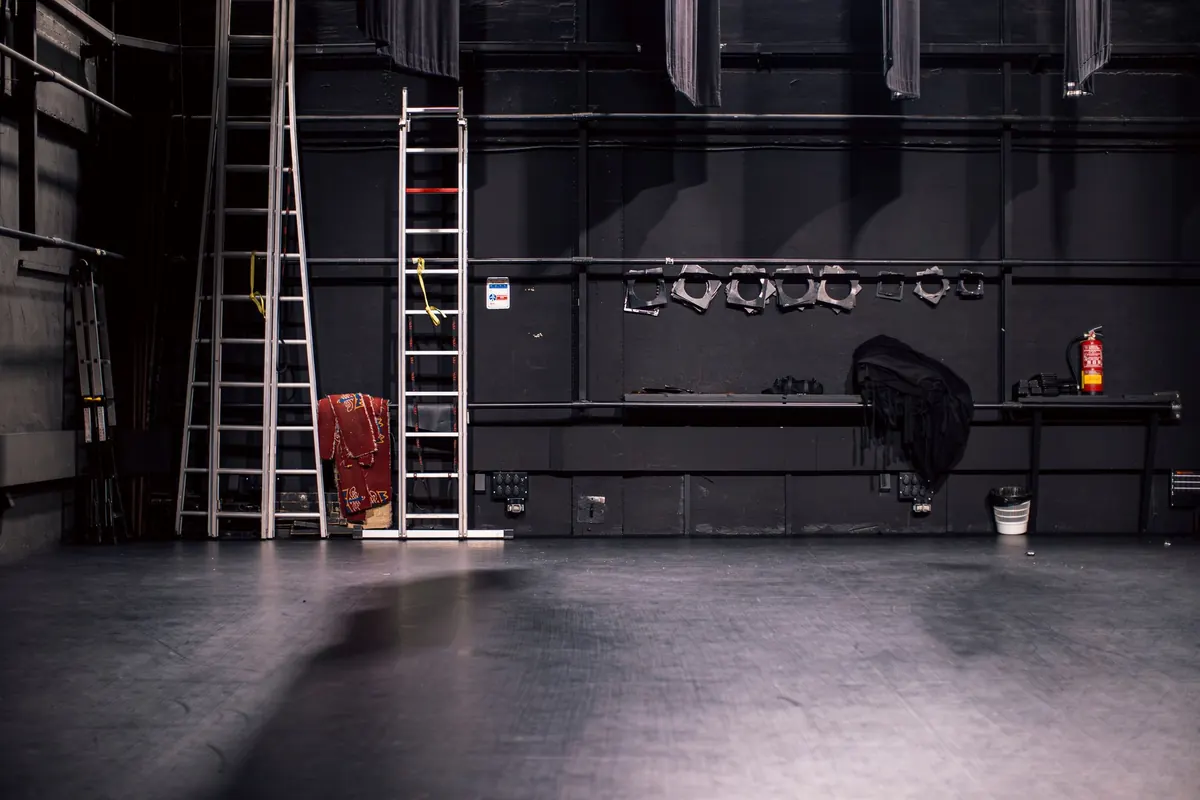
The house lights go down. At the back of the auditorium, at a small desk with a script open and one finger holding the page, someone speaks a single word into a headset. Something happens on stage. They speak again, or they don't, and the show continues.
That person is the stage manager. The title is printed in every programme and almost nobody outside the building knows what it involves. Here is what actually happens between the preset and the curtain call.
Call time is usually ninety minutes to two hours before curtain, and the first hour is physical. A stage manager walks the building rather than sitting at the desk, because most problems are easier to see than to hear about.
Safety is the part of the job that never appears in the programme. The technical team tests the safety curtain and the fire systems, but the stage manager is the person who notices a chair left in the wings in the dark, or that a newly added piece of set has narrowed the gap an actor runs through in a blackout.
The calls go out in the same order every night: the half at thirty-five minutes, the quarter at twenty, the five, and beginners to the stage. Between them, the stage manager confirms with front of house that the audience is in and the house is ready, then confirms each department in turn — lighting, sound, flys, automation, wardrobe, the cast.
Then come the opening standbys. Reading the first few cues aloud to the operators before the show starts costs thirty seconds and removes any doubt about who is doing what. The house goes to half, then out, and the night begins.
Cue calling looks simple from the outside. It is a vocabulary of two words, used in a fixed order, and the discipline of that order is what makes it work.
Standby LX 26, sound Q 14, fly Q 4. … LX 26, go. … Sound Q 14, go. … Fly Q 4, go.
A standby gives each operator time to put a hand on the fader or the button. The go is the only word that actually makes something happen. Separate standbys and separate gos mean that if one department isn't ready, the stage manager hears about it before the cue is due rather than after.
The calling script is the backbone. Cues are marked in pencil, timed to a line of text, a door slam, an actor's crossing, a blackout. Notes crowd the margins: wait for the laugh, hold until she's cleared the stairs, don't call the fly until the table is off. Pencil, always, because a cue will move during previews and the book has to survive being rewritten.
Half the skill is listening. A cue that depends on an audience — the laugh, the applause after a song, the silence after a bad line — can't be counted in seconds. You learn the shape of the room and you feel for the right beat.
During the show, the stage manager holds a map of the building in their head: who is on stage, who is in the wings, who is mid quick change, who is not where they should be. Entrance and exit points are marked in the book. Quick changes are cross-referenced with the dressers on headset.
This is why the answer to "where's the necklace?" arrives in four seconds flat. Someone on the rail saw it go past; wardrobe confirms the change is done; the book says the entrance is in ninety seconds. None of it is guesswork — it's a chain of people who each know their small piece.
Something will go wrong. A door won't latch, a fly won't move, a prop is left in the wrong wing, an actor misses an entrance. The job in that moment is not to fix the show. It is to keep the information moving so that somebody else can.
Panic travels down a headset faster than any instruction. A three-second pause before pressing the talk button turns "the door's stuck, the door's stuck" into "fly rail, door three isn't latching, can you take it on the next blackout?" One is noise. The other is a plan.
When a set piece fails, the options are usually: play around it, send a stagehand on in a blackout, or hold. A hold stops the performance and is a genuine last resort, but it exists, and everyone backstage should know what it sounds like before they ever hear it. When an actor is injured or a cue puts someone in danger, the hold comes immediately and the questions come afterwards.
Many disasters are invisible to the audience within ten seconds. An actor covers a missed entrance, an operator picks up a cue by eye, a dresser hands over the wrong coat and swaps it back in the wings. The best decision is often to let the performance carry on and write it down later.
Fifteen minutes, and a list to get through. Props are reset and checked against the second-act preset. Spills are mopped, the stage is swept, anything that broke in act one is swapped or taped. The second-act beginners are called. Notes about act one go on the pad for tomorrow's rehearsal or next week's maintenance visit.
The stage manager also checks in with front of house, confirms the house is ready to come back in, and makes sure the interval doesn't quietly run long. Then it's places again, and the whole sequence restarts with a slightly different script.
The curtain call is called like any other sequence, with its own standbys and gos. A long ovation means holding the final cue rather than cutting it; a speech or a presentation after the bows means marking a new ending in the book for tomorrow.
After the audience leaves, the paperwork starts. The show report records start and end times, audience numbers, technical faults, injuries, latecomers, anything unexpected. It reads like a dull administrative document. It is actually the memory of the production, and it is why the same fault doesn't happen twice.
Sit slightly to one side and a little further back than you normally would, and watch the wings during a blackout. You'll see the choreography of it: hands on a chair, a dresser waiting with a coat, two stagehands walking a sofa off in the dark on a count. Watch how quickly a scene change resolves after the last line of a scene.
Notice, too, whether you notice anything at all. A night where the machinery of the show never draws attention to itself is not a night where nothing happened. It is a night when a great deal happened quietly, in the right order, on cue.
Photo: Martin de Arriba / Pexels

A practical guide to reading Italian regional theatre seasons — the cartellone, subscription turns, surtitles,...

A practical guide to reviewing devised and experimental theatre: how to read movement, sound design, audience...

A practical guide for student journalists on interviewing playwrights: how to ask about process, revision and...

Capturing fleeting moments from the world of theatre.